Posts

Showing posts with the label SDR

Polyphase harmonic rejection mixer: AirSpy HF+

Image
Polyphase harmonic rejection mixer: AirSpy HF+ Introduction Can you get excited about a new mixer, usually boring devices that haven't changed in decades? Yes, the new polyphase harmonic rejection mixer in the AirSpy HF+ is almost as revolutionary as SDRs and will have a major influence on their design. The big advantage of a polyphase harmonic rejection mixer is that it acts as a RF filter for the selected signal, as well as suppressing harmonics and other aliases of the mixing process and local oscillator. It means that the mixer can virtually be connected to the antenna. Typically, a polyphase harmonic rejection mixer converts down to an ADC at base-band. It seems they can be used for both RX and TX. The post covers how the AirSpy HF+ works, and gives references to what I have been able to find out about polyphase harmonic rejection mixers. They are new and still covered by recent patents. A link to a PowerPoint gives general technical details of the mixer...

RF tap for panadaptor/second SDR after IC-7300 bandpass filters

Image
RF tap for panadaptor/second SDR after IC-7300 bandpass filters (First draft) Introduction It is possible to tap into the IC-7300 after the bandpass filters, just before the ADC. There is a coax connector that allows an SDR tap to receive the filtered RX signal. It is shared with the low-level TX path, but the levels are low, giving a TX monitor too. Using CAT controls, the SDR can be controlled by the TRX. It can also operate as a second RX in the operating band. The RF tap is an alternative to the INRAD RX7300-receive antenna cable, with some advantages and disadvantages. Finding the RF tap In an SDR-based TRX there is no IF tap point, but on the IC-7300, there is a RF tap point after the band pass filter and RF amplifier, where an SDR has the good filtering of the IC-7300, but can access the whole operating band. The RF tap point J1431 is shown in a portion of the RF unit schematic from the service manual. The schematic shows the RX, TX and power paths in green, brown and ...

Airspy, Spectrumspy, noise source and UHF cavity filter characteristics; a low cost spectrum analyzer?

Image
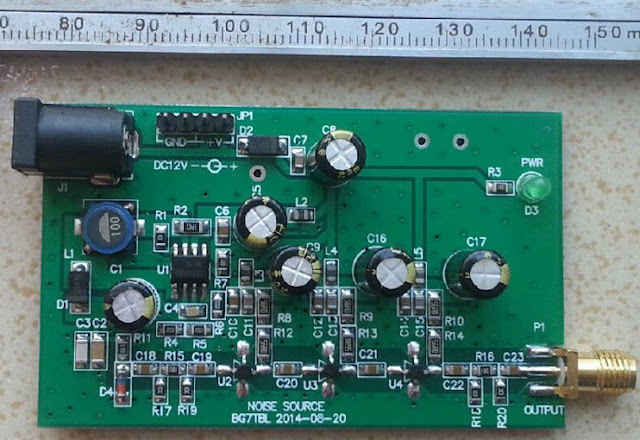
Airspy, SpectrumSpy, noise source and UHF cavity filter characteristics; a low cost spectrum analyzer? Introducton A basic spectrum analyzer/tracking generator for less than $250? Yes. Can it be used to do a demanding task like tuning a UHF cavity filter from a repeater? Seems so. The "proof of concept", spectrum analyzer software, SpectrumSpy, can be used with the Airspy SDR and a noise source to show the characteristics of a pass-reject UHF cavity filter. SpectrumSpy and Airspy SpectrumSpy, "proof of concept", spectrum analyzer software is a new addition to the SDR# download for use with the Airspy SDR. It has the potential for a new direction with low cost SDRs, spectrum analyzers.  Spectrum analyzers are expensive; $1500 then skyward. SpectrumSpy: http://airspy.com/download/ (separate executable in SDR# folder). Airspy has a 24 – 1800 MHz native RX range, but down to DC with the SpyVerter option. http://airspy.com/ $199  and US$59 An earlier post is...

Low cost spectrum analyser/ scanner with AirSpy and RTLSDR

Image
Low cost spectrum analyser/scanner software for the Airspy and RTL-SDR Introduction It is not often I am amazed at new technology, especially for free, but the Spectrum Spy software, a spectrum analyser/scanner for the Airspy SDR, impressed me. It is a poor man's spectrum analyser. However, it is preceded by at least two spectrum scanners for the RTL-SDR hardware; rtl_power and RTLSDR Scanner . This post will compare the two devices and three software packages, scanning the entire FM band and the 100 MHz of the local TV band. The software The three programs all run under Windows, Windows 10 in my case. All three installed and ran without much difficulty. Spectrum Spy is part of the SDR# software package. It is a separate program to SDR#, but in the same folder. Spectrum Spy has a spectrum and a waterfall. It updates every few milliseconds, depending on the span. Spectrum Spy only works with the US$199 Airspy. I have a V1 Airspy. RTLSDR-Scanner is a stand-alone prog...

New TRX- IC-7100, a look inside

Image
New TRX- IC-7100, a look inside I have just purchased a new IC-7100 to replace the FT-857 and FT-897 all-band, all-mode TRX I had. The Yaesu TRX were good radios, but dated designs. The IC-7100 on the other hand is a very modern design and radical form with a separate touch screen controller. The IC7100 is a similar but different design to other modern Icom TRX such as the IC-7410 and IC-9100. All are software-defined radios, with all modulation and demodulation done in software/firmware in the DSP and codec chips. All other signal processing is also done in software. Analogue devices are used for amplifiers and mixers. Band, low-pass and roofing filtering is done with discrete components, but all signal filtering is done by the DSP. I will say more of the design, but for the moment I have some photos of the main unit's PCBs. The mechanical design is simple. The top board is the frontend for both Rx and Tx with most components of one side of the board mainly bec...

It lives! BladeRF SDR on Windows using SDR Console V2: 30 MHz bandwidth, 300-3.8GHz

Image
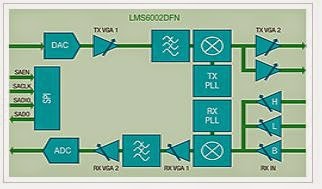
Summary of BladeRF SDR TRX BladeRF is a high performance SDR transceiver made by a small start-up company, Nuand http://www.nuand.com/bladeRF . Currently only mainboard is available for US$420, with a HF/VHF transverter due late November to give coverage down to 10 MHz. For receive only, an up-converter for RTL-SDR dongles could be used to go lower. Technical Specifications: •Fully bus-powered USB 3.0 SuperSpeed Software Defined Radio •Portable, handheld form factor: 5" by 3.5" •Extensible gold plated RF SMA connectors •300MHz - 3.8GHz RF frequency range •Independent RX/TX 12-bit 40MSPS quadrature sampling:  LMS6002D is a field programmable RF  transceiver http://www.limemicro.com/products/LMS6002D.php     •Capable of achieving full-duplex 28MHz channels •16-bit DAC factory calibrated 38.4MHz +/-1ppm VCTCXO •On-board 200MHz ARM9 SOC with ...

Low-cost Amateur Digital Television- DVB-T ATV using UT-100C transmitter USB dongle

I am setting up a DVB-T tx on the atv channel on 70 cm. I am using a UT-100c USB dongle http://www.hides.com.tw/product_eng.html   http://www.idealez.com/hides/product-detail/en_US/69859 . It is only US$169 and produces 1 mW of DVB-T output. The software is at https://drive.google.com/folderview?id=0BzoVnSl8XNdQMmZPbDhEczA2RjA&usp=shar ing . There are some pdfs of the device and how the software works.   To use the dongle, only the windows driver and PC2TV are needed. With PC2TV, only the video works at the moment. PC2TV takes a deal of setting up but will work with a PC/laptop webcam.   Only the UT-100C dongle is needed to start. Some ordinary domestic DVB-T receivers can be used.  The DVB-T channels in Australia are 7 MHz wide, the same as free to air TV. As such, the standard Australian DVB-TV settings can be used. At 1 mW, it is possible to xmit on a free commercial channel and tune a TV to it, without causing any dramas. How...